
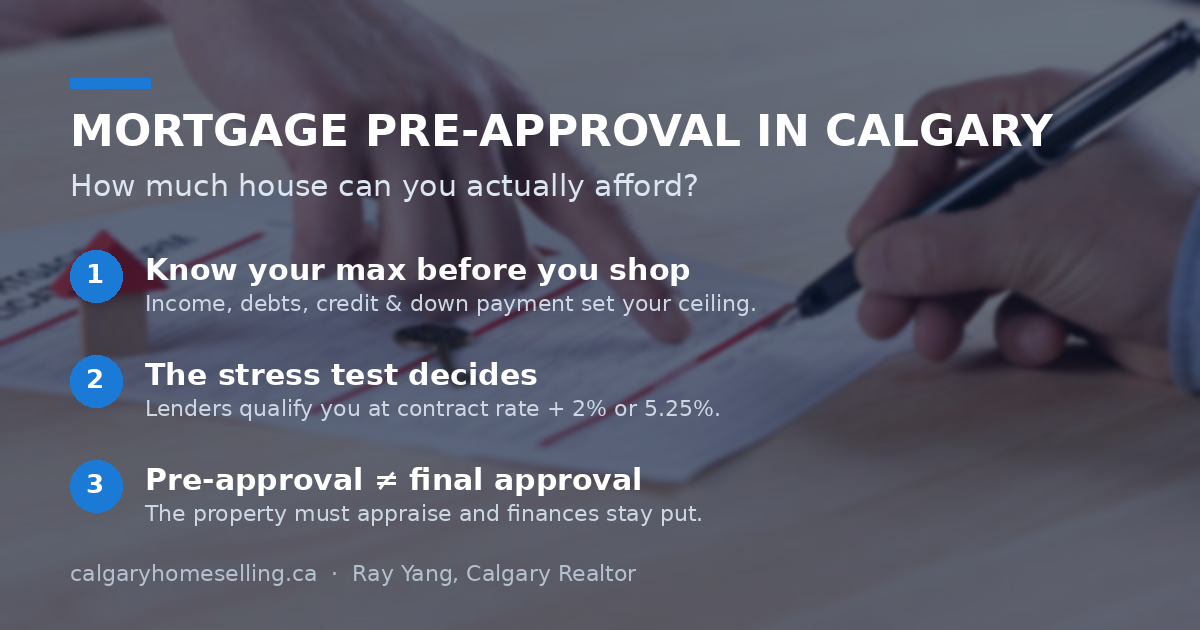
A mortgage pre-approval tells you the maximum a Calgary lender will lend you, based on your income, debts, credit score and down payment — and typically holds your rate for 90 to 120 days. With Calgary's residential benchmark at $566,700 in September 2026 (CREB), most buyers need a pre-approval in the $450,000–$750,000 range.
If you're buying your first home in Calgary — or your next one — the pre-approval is the single most useful number in your search. It stops you from falling in love with a $750,000 detached home when your budget tops out at $540,000, and it tells sellers you're serious when you write an offer. Here's exactly how lenders arrive at that number, and how to read it.

What Does a Mortgage Pre-Approval in Calgary Actually Cover?
A pre-approval is a lender's conditional commitment: "Based on what you've told us and the documents you've shown, we'll lend you up to $X at roughly Y%." It is not a final approval. The lender still needs to verify everything and approve the specific property — including an appraisal — before funding.
What a pre-approval gives you:
- Your maximum purchase price, so you shop in the right price band from day one.
- A rate hold, usually 90 to 120 days. If rates rise while you shop, you're protected at the held rate. If rates fall, you typically get the lower rate.
- Credibility with sellers. In a competitive situation, an offer with a pre-approval letter beats one without it, every time.
- A reality check on your budget — sometimes the number is higher than expected, sometimes lower. Better to know now.
A pre-approval is free, and it usually takes one to three business days once your documents are in.
How Lenders Calculate Your Maximum: The 4 Levers
Lenders don't guess. Your pre-approval amount comes from four inputs:
| Lever | What the lender looks at | Why it matters |
|---|---|---|
| Income | Gross household income, verified by pay stubs, employment letter and tax documents | Sets the ceiling — housing costs are measured against it |
| Debts | Car loans, credit-card balances, student loans, lines of credit | Every dollar of monthly debt shrinks your mortgage room |
| Credit score | Typically 600+ minimum for an insured mortgage; 680+ unlocks better rates | Determines whether you qualify and at what rate |
| Down payment | Minimum 5% on the first $500,000 (CMHC rules); under 20% needs mortgage insurance | Sets your loan size and whether insurance premiums apply |
The key ratios are Gross Debt Service (GDS) and Total Debt Service (TDS). For an insured mortgage, CMHC guidelines generally cap housing costs at 32% of gross income (GDS) and all debt payments at 40% (TDS). "Housing costs" means your mortgage payment plus property tax, heating and half of any condo fees.
The Stress Test: Why You Qualify for Less Than You Think
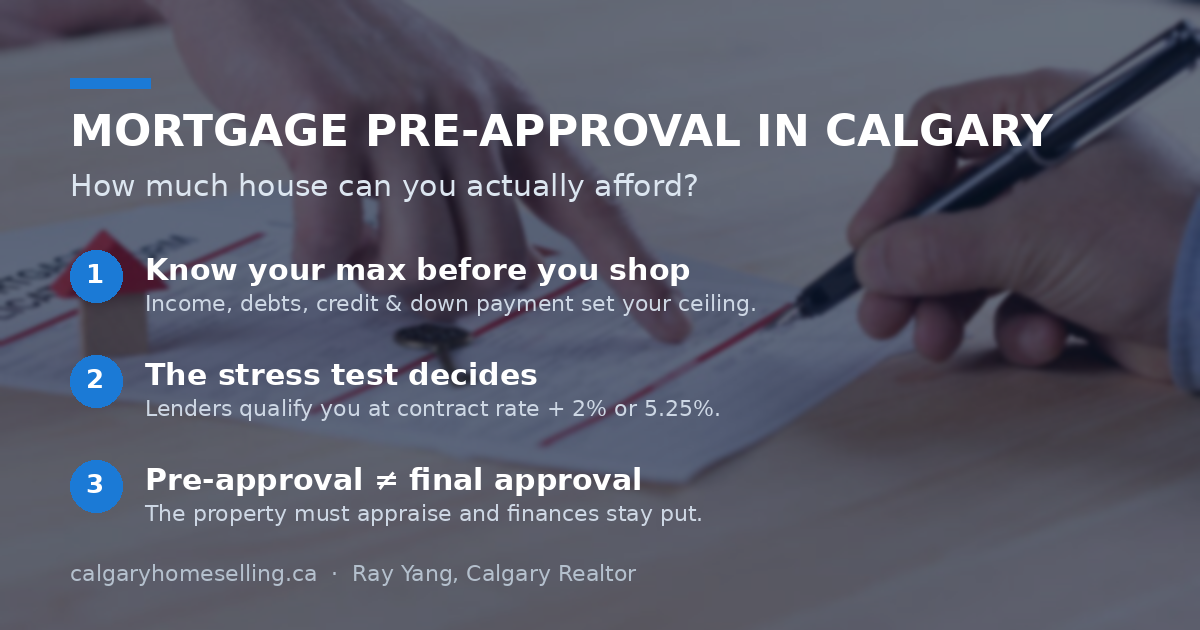
Here's the part that surprises most buyers. Lenders don't qualify you at your actual contract rate. Under the federal stress test, you must qualify at the higher of your contract rate plus 2%, or 5.25%.
So if your lender quotes you 4.75%, your affordability is tested at 6.75%. That higher test rate is what determines your maximum mortgage — not the rate you'll actually pay. The logic is simple: the lender wants proof you can still afford the payments if rates rise at renewal.
This is why two buyers with identical incomes can get different pre-approval amounts: the one with a car loan and a maxed-out credit card qualifies for less, because their existing debts eat into the 40% TDS ceiling.
Minimum Down Payments in Canada (2026 Rules)
Federal rules set the minimum down payment by price tier. Since December 2024, insured mortgages are available on homes priced up to $1.5 million:
- Up to $500,000: 5% down
- $500,000 to $1,500,000: 5% on the first $500,000, plus 10% on the portion above $500,000
- Above $1,500,000: 20% down (no mortgage insurance available)
Applied to Calgary's September 2026 benchmark prices (CREB), the minimums look like this:
| Property type | Sep 2026 benchmark (CREB) | Minimum down payment |
|---|---|---|
| Apartment | $291,400 | $14,570 |
| Row / townhome | $412,400 | $20,620 |
| All residential | $566,700 | $31,670 |
| Detached | $739,400 | $48,940 |
Note the trap at $500,000: buyers hear "5% down" and budget 5% of their target price. On a $700,000 home the real minimum is $45,000 — that's 6.4%, not 5%. On the $566,700 benchmark it's $31,670. Budget for the tiered math, not the headline.
First-time buyers and buyers of newly built homes may also qualify for a 30-year amortization on an insured mortgage (standard is 25 years), which lowers the monthly payment and stretches the same income further.
CMHC Insurance: The Added Cost of Less Than 20% Down
Putting down less than 20% means the lender requires mortgage default insurance (through CMHC, Sagen or Canada Guaranty). The premium is a percentage of the mortgage amount, added to your loan — you don't pay it upfront, but you pay interest on it:
- 5% – 9.99% down → 4.00% of mortgage amount
- 10% – 14.99% down → 3.10%
- 15% – 19.99% down → 2.80%
- 20% or more → None required
Example: on a $500,000 home with 5% down, the mortgage is $475,000 and the premium adds about $19,000 — so you start with a $494,000 mortgage. That's the real cost of buying sooner with a smaller down payment, and your pre-approval accounts for it.
Worked Example: What Does $150,000 of Income Buy in Calgary?
Let's run the math for a household earning $150,000 with no car loans or credit-card debt. Assumptions are stated — your lender will run your exact numbers:
- Max housing costs (32% GDS): $150,000 × 32% ÷ 12 = $4,000/month
- Subtract property tax and heat (say $550/month combined): $3,450/month left for the mortgage payment
- At an illustrative 7% qualifying rate over 25 years, $3,450/month supports roughly a $488,000 mortgage
- With 10% down, that mortgage buys a home priced around $540,000
That lands just under Calgary's $566,700 September 2026 benchmark (CREB) — meaning a $150,000 household with 10% down and no other debts can reach roughly the average Calgary home. Add a $600/month car payment to the picture and the TDS ceiling pulls that number down by roughly $85,000. Debts are the silent budget-killer.
Want to run your own numbers? Try our mortgage calculator.
Your Pre-Approval Document Checklist
Have these ready and most lenders turn your pre-approval around in one to three business days:
- Government-issued photo ID
- Employment letter and recent pay stubs (or two years of tax returns and Notices of Assessment if self-employed)
- Proof of down payment — bank statements showing 90 days of history
- A list of all debts with monthly payments and balances
- If your down payment includes a gift, a signed gift letter from the giver
One practical tip: don't move large sums between accounts in the months before you apply. Every deposit gets questioned, and unexplained money slows everything down.

5 Mistakes That Shrink (or Kill) Your Pre-Approval
- Shopping at your maximum. Your pre-approval is a ceiling, not a target. Leave room for rate changes, closing costs and life.
- Taking on new debt. That financed truck between pre-approval and closing can torpedo your final approval. Freeze big purchases until you have the keys.
- Changing jobs. A job switch — even to a higher salary — can spook underwriters mid-file. If a move is unavoidable, talk to your lender first.
- Assuming the pre-approval is final. The property still has to appraise, and your finances must look the same at closing as they did at pre-approval.
- Letting the rate hold expire. Most holds last 90 to 120 days. If your search runs long, ask your lender to renew it before it lapses.
For context on where prices are heading while you shop, our October market update breaks down September's CREB numbers — 1,650 sales and a $566,700 benchmark in a roughly balanced market.
Frequently Asked Questions
How long does a mortgage pre-approval take in Calgary?
With your documents ready, most lenders and brokers issue a pre-approval in one to three business days. Self-employed buyers or complex income situations can take a little longer while the lender verifies income history.
Does getting pre-approved hurt my credit score?
A pre-approval triggers one hard inquiry, which may dip your score a few points temporarily. But credit bureaus generally treat multiple mortgage inquiries within a short shopping window as a single inquiry — so comparing two or three lenders won't multiply the damage.
Can I get pre-approved with less than 20% down in Calgary?
Yes. The minimum is 5% on the first $500,000 of the price (then 10% on the portion above, up to $1.5 million). Below 20% down, mortgage default insurance is required and its premium is added to your loan. On Calgary's $291,400 apartment benchmark (CREB, September 2026), the minimum down payment is just $14,570.
Is a pre-approval a guaranteed mortgage?
No. It's a conditional commitment based on your finances at the time of application. Final approval requires the specific property to appraise at value and your financial picture to be unchanged at closing. Keep your debts, deposits and employment stable between pre-approval and possession day.
Should my pre-approval cover more than the asking price?
Pre-approve for your comfortable maximum, then shop below it. In Calgary's roughly balanced fall 2026 market, most homes are selling near their list price rather than far over it — so a pre-approval at your true max gives you room to compete without stretching past what you can afford.
A pre-approval takes a few days and costs nothing — but it changes how you shop. Run your own numbers on our mortgage calculator, and when you're ready to talk through what you can comfortably afford in this market, reach out. A quick conversation now beats falling for a home outside your range later.
Posted by Ray Yang onEnjoy this blog post? Click here to subscribe for updates
Leave A Comment