

SE Calgary Neighbourhoods: 8 Best Communities to Live In
Two houses can be the same price in SE Calgary and feel like completely different lives. One puts you walking to coffee and live music in an older inner-city pocket. The other lands you in a newer south community where errands are easy, parks are newer, and the weekend revolves around a lake (and the traffic that comes with it).
This shortlist is built for buyers who want to narrow options fast, before they waste weekends bouncing between showings that don’t match their routine. You’ll get quick, practical context on what each community is actually like day to day—who it fits, what tradeoffs show up after the first month, and what to watch for when you’re comparing similar homes.
Start with the things you can’t change cheaply: your commute pattern, school logistics, parking and yard setup, and whether you’ll truly use lake access enough to justify the fees and crowds.
If you want MLS-based shortlists by price, bedrooms, or school proximity, Calgary Home Selling can pull active listings and comparable sales for each neighbourhood.

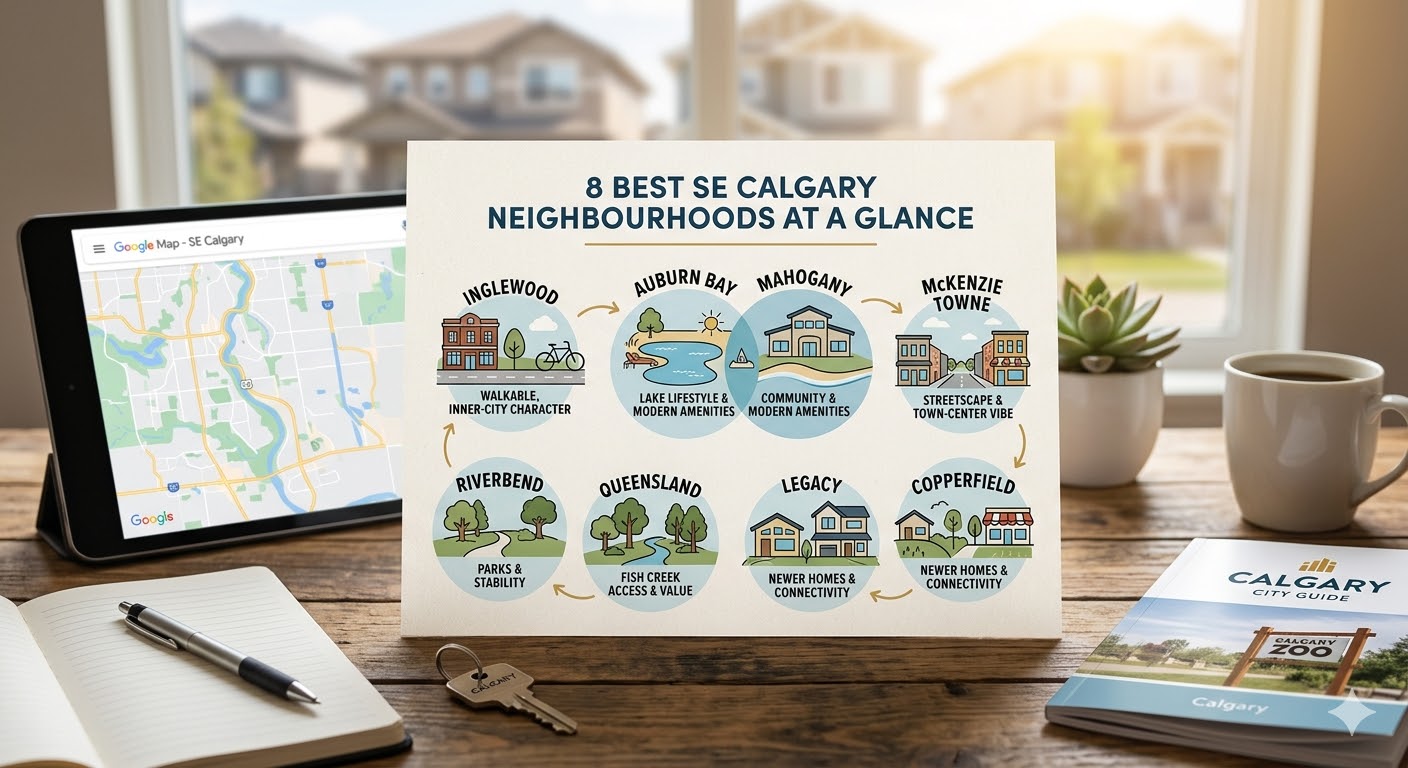
8 Best SE Calgary Neighbourhoods at a Glance
1. Inglewood
Inglewood is the SE Calgary pick for buyers who want a real inner-city neighbourhood: older homes, independent shops, and a day-to-day life you can do on foot or bike. It fits professionals who work downtown, couples who want restaurants and live music close by, and downsizers who prefer character over square footage.
Housing in Inglewood skews older and varied. You will see early-1900s character houses, post-war bungalows, townhomes, and low-rise condos, plus modern infills on select streets. Lots can be smaller and parking can be tighter than suburban SE, so check alley access, garage options, and street permit realities during showings.
Walkability is the headline feature. The 9 Ave SE corridor anchors the neighbourhood with local staples like Inglewood Drive-In, Cold Garden Beverage Company, and Recordland Limited. You can run errands, meet friends, and still get home without touching Deerfoot Trail.
Bow River Pathway Life And Flood-Risk Homework
The Bow River pathway and Pearce Estate Park make it easy to bike commute or get outside fast. Many buyers use the pathway connection to downtown and the Calgary Zoo area as a deciding factor, especially if they want an active lifestyle without driving to it.
Flood risk is the tradeoff you must treat seriously in river-adjacent parts of Inglewood. Do your homework street by street, not by neighbourhood name. Start with the City of Calgary flood maps and ask direct questions about past water events, basement development permits, sump pumps, backwater valves, and insurance history.
Calgary Home Selling can build an MLS shortlist that filters for elevation cues, finished basements, and specific blocks, then book tours so you can compare the “cool factor” against the practical stuff.
2. Riverbend
Riverbend rewards buyers who care more about day-to-day livability than flashy new builds. It is a steady, family-first pocket in SE Calgary with real tree canopy, practical streets, and quick access to the Bow River pathway system.
The centre of gravity is Carburn Park, one of the area’s biggest lifestyle perks. You get ponds, picnic areas, and long, flat paths that work for strollers, dog walks, and bike commutes. If you want weekend nature time without driving to Kananaskis, Riverbend delivers.
Homes, Schools, And The Daily Routine
Most homes read as classic late-20th-century Calgary: 1980s to 1990s detached houses with attached garages, plus some townhomes. Expect more traditional floorplans, more defined rooms, and fewer “open concept” great rooms unless a home has been renovated. Lots often feel usable, with backyards that fit a playset or garden.
School access is one reason Riverbend keeps showing up on family shortlists. You can often plan a routine around nearby elementary options and a quick drive to larger hubs for middle and high school programs. Before you commit, verify catchments and program availability with the Calgary Board of Education and the Calgary Catholic School District.
Commutes skew driver-friendly. Deerfoot Trail and Glenmore Trail sit close enough to matter, which helps with airport runs and cross-city trips, but it also creates noise pockets. Pay extra attention to homes backing onto major roads, busier connectors, and the edges closest to Deerfoot. Calgary Home Selling can set up MLS searches that flag backing exposures and help you compare quieter interior crescents against the convenience of faster exits.
3. Auburn Bay
Auburn Bay is where SE Calgary’s “convenience vs noise pockets” tradeoff becomes “lake lifestyle vs peak-season traffic.” If you will use the water, the beach, and the skating loop, Auburn Bay can feel like you bought a vacation routine with your house.
Most housing is mid-2000s to newer: detached homes, laned homes, townhomes, and condos. Streets closer to the lake and Auburn House tend to feel busier in summer. Quieter value often sits on interior crescents that still keep you within a short walk or bike ride.
Lake Living, Amenities, And Day-To-Day Logistics
The private lake and Auburn House clubhouse anchor the community. Residents use the beach, paddle and swim in summer, then switch to skating and community events in winter. If you want “walk to an activity” for kids, Auburn Bay delivers better than most non-lake suburbs.
School access is a major reason families shortlist Auburn Bay. Before you commit, confirm the current walk zone, program options, and overflow patterns with the Calgary Board of Education or the Calgary Catholic School District. In fast-growing areas, boundaries and capacity can change your daily routine more than your floorplan.
Seton sits next door for errands and entertainment, and the South Health Campus makes Auburn Bay a practical pick for healthcare workers or anyone who wants a major hospital nearby. Your commute options lean heavily on Deerfoot Trail and Stoney Trail, so test-drive the route at your real departure time.
Budget for the lake/HOA fees and ask what they cover. Then pressure-test summer realities: heavier traffic near 52 Street SE and Seton, more visitor parking pressure, and busier access points around the lake. Calgary Home Selling can filter MLS results for lake access, condo fees, and backing exposures so you can compare “near the action” against “quiet and easy to park.”

4. Legacy
If lake fees and peak-season crowds feel like a tax on your weekends, Legacy is the cleaner play for newer homes and everyday convenience. It is a deep-south SE Calgary community where a lot of buyers trade inner-city proximity for newer construction, newer parks, and quick errands.
Legacy fits first-time buyers who want a modern layout without paying for a private lake, plus move-up buyers who want a newer detached home with a garage and a manageable yard. It also attracts commuters who use Stoney Trail regularly and prefer to stay close to the ring road.
Newer-Home Value, Pathways, And Shopping
Legacy’s value pitch is simple: you can often get a newer build, newer mechanical systems, and more current finishes than established SE neighbourhoods at the same price point. The tradeoff is lot size. Many pockets have narrower lots and closer rear-lane neighbours, so check backyard depth, deck space, and where the sun actually hits the yard.
The community’s pathway network is a real quality-of-life feature. You can string together dog walks, stroller loops, and playground stops without crossing major roads as often as you do in older subdivisions.
For errands, many residents default to Legacy Village and nearby big-box nodes along Macleod Trail. This is a drive-first setup, but it reduces the “15-minute trip for one item” problem.
Growth is the other reality to price in. Legacy keeps changing at the edges, so you should ask about future phases, current construction routes, and how long you will live beside grading and framing. The City of Calgary Development Map helps you check what is approved nearby.
Calgary Home Selling can build an MLS shortlist that filters for lot width, alley access, finished basements, and homes that back onto greenspace so you can separate “newer and tight” from “newer and livable.”
How Do You Choose Among Mahogany, McKenzie Towne, Queensland, and Copperfield?
When you are splitting hairs between four solid SE communities, stop obsessing over granite, paint, and staging. Prioritize the stuff you cannot change cheaply: commute pattern, school routine, yard and parking, and whether you will actually use a lake.
A Practical (Slightly Contrarian) Decision Framework
Ignore the “newer is always better” reflex. A well-kept 1970s home near Fish Creek can beat a newer house if you value trees, lot size, and quick park access. Focus on mechanical updates, layout, and the block.
Choose your traffic battle on purpose. Deerfoot Trail and Stoney Trail feel different at real rush-hour times. Before you fall in love with a listing, drive the route at your departure time and do a grocery run at 5 p.m.
Pay for lifestyle only if you will use it. Lake access in Mahogany brings fees and summer crowds. If you will paddle, swim, skate, and go to resident events, it pencils out. If you will go twice a year, buy the house without the fee.
Use these quick rules to narrow fast:
-
If you want the biggest lake lifestyle and newer upscale pockets: pick Mahogany (also strong for Mahogany Village Market and pathways near wetlands).
-
If you want a walkable, planned streetscape with a town-center feel: pick McKenzie Towne (High Street retail and lots of front-porch streets).
-
If you want mature trees, larger yards, and Fish Creek access on a tighter budget: pick Queensland (then get serious about renovation quality and windows, electrical, and insulation).
-
If you want newer-ish inventory that often prices below lake communities: pick Copperfield (watch school and childcare competition, plus peak bottlenecks on connectors).
If you want this decision to feel obvious, ask Calgary Home Selling for MLS shortlists that filter by backing exposure, school proximity, and fee structures, then book three showings in each area on the same day. The contrast does the math for you.

SE Calgary Neighbourhoods: Frequently Asked Questions
The "Vibe" Check: Finding Your Lifestyle
Q: Which SE neighbourhood feels the most like a "small town" within the city? A: McKenzie Towne is the top pick for this. It was designed with a "New Urbanism" philosophy, meaning it features front-porch streetscapes and a centralized High Street with local shops and cafes, making it very walkable compared to traditional suburbs.
Q: I want an inner-city lifestyle with character. Where should I look? A: Inglewood is your best bet. It’s Calgary’s oldest neighbourhood and offers a mix of heritage homes, trendy boutiques, and live music venues. It’s perfect if you want to bike to work downtown and avoid the suburban commute.
Q: We are a "nature-first" family. Which area has the best park access? A: You have two great options:
-
Riverbend: Offers direct access to Carburn Park and the Bow River pathway system.
-
Queensland: Sits right on the edge of Fish Creek Provincial Park, perfect for hiking and spotting wildlife right outside your door.
The Practicalities: Money, Schools & Commutes
Q: Is "Lake Living" worth the extra cost? A: It depends on your weekend routine. In communities like Auburn Bay and Mahogany, you will pay mandatory HOA fees. If your family will use the private beach, paddleboards, and skating loops weekly, it’s a great value. If you only visit the lake twice a year, you’re better off looking at Copperfield or Legacy, where you get similar housing without the lake premium.
Q: Which area is best for first-time buyers on a budget? A: Queensland and Copperfield are strong contenders. Queensland offers older homes with larger yards (ideal if you’re handy and want to renovate), while Copperfield offers newer inventory and townhomes that are often priced more competitively than the neighbouring lake communities.
Q: I work downtown. How do the commutes compare? A: Inglewood is the fastest (often just a few minutes). Riverbend and Queensland have solid access via Deerfoot Trail. If you move further south to Legacy or Auburn Bay, you are looking at a longer drive, though they are well-connected via Stoney Trail if you need to zip around the rest of the city.
The "Watch-Outs": What to Check Before Buying
Q: What should I look for when buying in an older area like Inglewood? A: Flood-risk due diligence is a must. Check the City of Calgary flood maps and ask about basement permits, sump pumps, and insurance history. Also, be prepared for tighter parking and potential noise from the nearby rail lines.
Q: What is the biggest trade-off when buying a "New Build" in Legacy? A: Lot size and construction. While you get a shiny new house with modern mechanicals, the lots are often narrower, and you may be living near active construction for a few years as the community finishes its growth phases.
Q: Why should I care about "School Catchments" if I don't have kids yet? A: Resale value. Even if you don't need the school, the next buyer likely will. In fast-growing areas like Auburn Bay and Copperfield, schools can reach capacity quickly, leading to "overflow" patterns. Always verify current boundaries before you sign.
Connect with Ray today at CalgaryHomeSelling.ca to take the next step in your SE Calgary home search.
Posted by Ray Yang on
Enjoy this blog post? Click here to subscribe for updates
Leave A Comment