

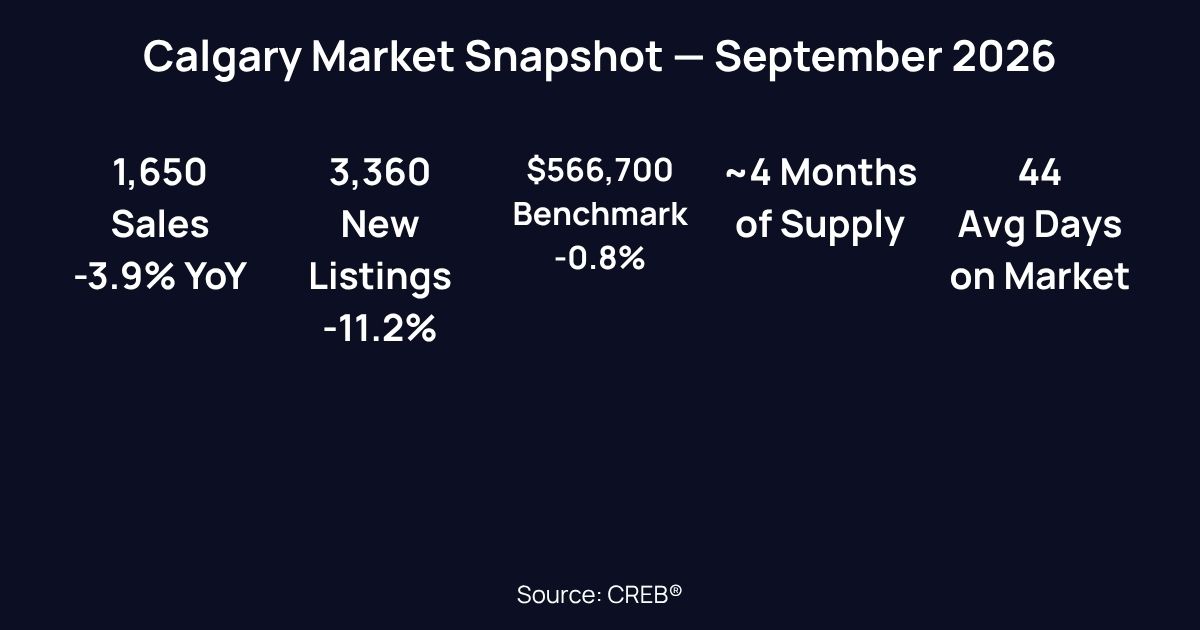
September in Calgary was a tale of two markets. The city recorded 1,650 home sales, down 3.85% from a year earlier, while the benchmark price eased 0.82% to $566,700, according to official CREB statistics released October 1, 2026. Detached homes held steady, but apartment and row prices kept sliding under the weight of years of new high-density construction.

How did the Calgary housing market perform in September 2026?
September's 1,650 sales were nearly identical to August's 1,660, suggesting the market has settled into a steady rhythm after a choppier first half of the year. Year-over-year sales dipped 3.85%, but that modest decline came alongside a meaningful pullback in new supply: 3,360 new listings hit the market, down 11.16% from September 2025. With fewer fresh listings arriving, active inventory also tightened to 6,502 listings, a 6.12% annual decline.
The balance between supply and demand tilted slightly in buyers' favour. The sales-to-new-listings ratio landed at 49%, while months of supply held at just under four months, unchanged from August. That combination points to a market that is neither overheated nor frozen — closer to balanced conditions, with enough choice for buyers to be selective but not so much inventory that sellers are forced into deep discounts across the board.
On pricing, the headline benchmark of $566,700 was down 0.82% from last September. Beneath the surface, the median sale price actually climbed 2.49% to $574,444 and the average price rose 4.93% to $646,198 — a reminder that the mix of homes changing hands can move averages even when the benchmark for a typical property softens. Homes took a little longer to sell, averaging 44 days on market compared with 42 days a year ago.
Which property types gained value — and which lost?
The September numbers make one thing clear: Calgary is not one market but several, and the gaps between segments are widening. Ground-oriented homes remain the market's anchor, while higher-density segments continue to adjust.
| Property type | Benchmark price | Year-over-year change |
|---|---|---|
| Detached | $739,400 | -1.0% |
| Semi-detached | $685,200 | +0.1% |
| Row | $412,400 | -5.5% |
| Apartment | $291,400 | -8.3% |
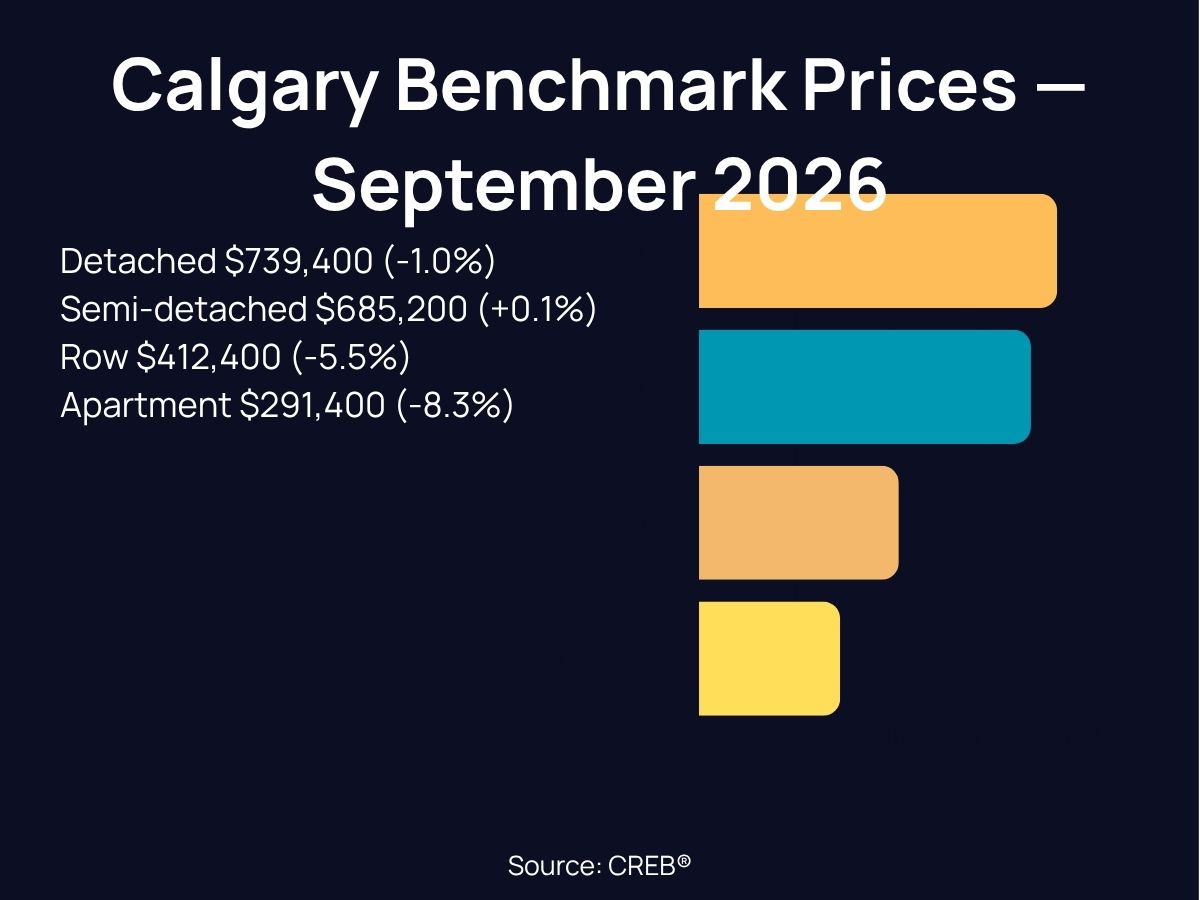 Detached homes, at a $739,400 benchmark, slipped just 1% year over year — essentially flat in a market where single-family supply remains the scarcest. Semi-detached homes did marginally better, edging up 0.1% to $685,200. The pressure is concentrated in higher-density housing: row-style homes fell 5.5% to $412,400, and apartment-style condos dropped 8.3% to $291,400. That divergence is the defining story of Calgary real estate in 2026.
Why are condo prices falling while detached prices hold?
According to CREB chief economist Ann-Marie Lurie, the answer traces back to construction. The building boom of the past three years was concentrated mostly in higher-density sectors, significantly increasing the supply of apartment and row-style homes. On the demand side, a stronger job market and positive net migration kept buyer appetite healthy enough to absorb some of that new supply — but not enough to offset it entirely. The result: higher-density prices have taken the harder hit, while the detached segment, where new supply is far more constrained, has held its value.
For context, last month's market update described a balanced market favouring buyers, and September's data extends that theme with an even sharper split between segments. If you're deciding between a condo and a detached home this fall, the price trends are moving in opposite directions — which changes the math on both sides of the transaction.

What does this market mean for Calgary buyers?
If you're buying a condo or row-style home, conditions are the most favourable they've been in years. Prices are down, selection is comparatively strong, and sellers in these segments are negotiating. With apartments 8.3% cheaper than a year ago, first-time buyers who were priced out of the detached market may find genuine opportunity — especially if they plan to hold long term and can ride out further near-term softness.
Detached buyers face a different reality. Prices are essentially flat, inventory is tighter, and well-priced single-family homes still attract attention. That doesn't mean overpaying: with 44 average days on market and a sub-50% sales-to-new-listings ratio, you have room to negotiate and time to do your homework. Get pre-approved, watch this week's newly listed homes closely, and be ready to move when the right property appears — but don't feel forced into bidding wars that the data doesn't support.
Across all segments, the slower pace is your friend. Use the extra days on market to arrange thorough inspections, compare recent comparable sales, and understand exactly what you're buying. In a balanced market, patience is a strategy.
What does this market mean for Calgary sellers?
Sellers need to price to the segment, not the city average. Detached and semi-detached owners can take confidence from benchmarks that are flat to slightly up — but “flat” still demands sharp pricing, strong presentation, and realistic expectations on timelines, with homes averaging 44 days to sell. Overpricing in this environment simply extends your days on market and invites low offers later.
Condo and row-home sellers face the toughest conditions. With apartment benchmarks down 8.3% year over year, pricing ahead of the market is a costly mistake. If you must sell this fall, price competitively from day one, highlight what sets your unit apart — updated interiors, strong condo documents, desirable location — and consider getting a free comparative market analysis so your list price reflects today's reality rather than last year's hopes.
One bright spot for sellers: new listings are down more than 11% year over year, which means less direct competition than last fall. Well-priced, well-presented homes in any segment can still sell — they just can't rely on the frenzy of previous years to do the work.
Calgary real estate FAQs — October 2026
Is Calgary in a buyer's market right now?
Close to it. A 49% sales-to-new-listings ratio and just under four months of supply sit near balanced territory, leaning toward buyers — especially in the apartment and row segments where supply is heaviest. Detached homes remain more balanced.
Are Calgary condo prices expected to keep falling?
The 8.3% annual decline in apartment benchmarks reflects several years of elevated high-density construction meeting demand that, while solid, hasn't fully absorbed the new supply. Until that supply-demand gap narrows, pressure on condo prices is likely to persist. Buyers should budget for the possibility of further softness; sellers should price accordingly.
How long are Calgary homes taking to sell?
The average was 44 days on market in September 2026, up from 42 days a year earlier. That's a modest slowdown consistent with a balanced market — far from the frantic pace of past seller's markets, but not a standstill either.
Is now a good time to buy a detached home in Calgary?
Detached benchmarks are down just 1% year over year at $739,400, so values are holding. With steady sales, easing competition from fewer new listings, and negotiating room from longer days on market, patient buyers can find fair value — particularly if they're pre-approved and monitoring new inventory weekly.
Where can I see the newest Calgary listings each week?
You can browse newly listed homes updated weekly, and if you're thinking of selling, start with a free home evaluation to see what your property could command in today's segmented market.
Market statistics cited in this update are from the Calgary Real Estate Board (CREB), released October 1, 2026, covering September 2026 activity.
Posted by Ray Yang onEnjoy this blog post? Click here to subscribe for updates
Leave A Comment