
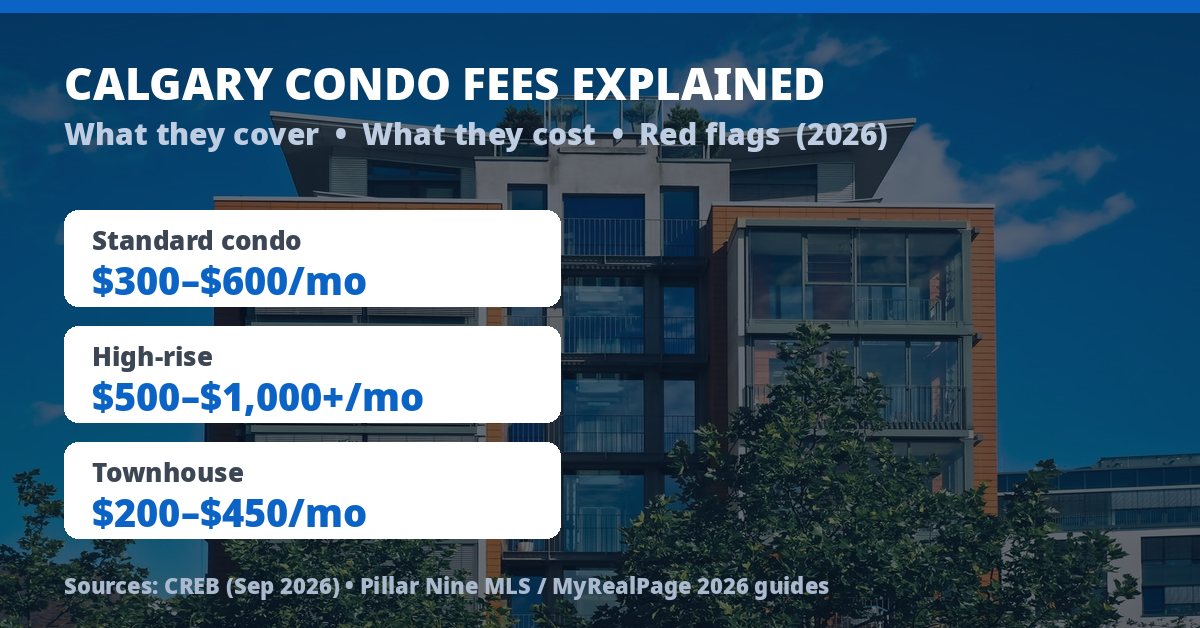
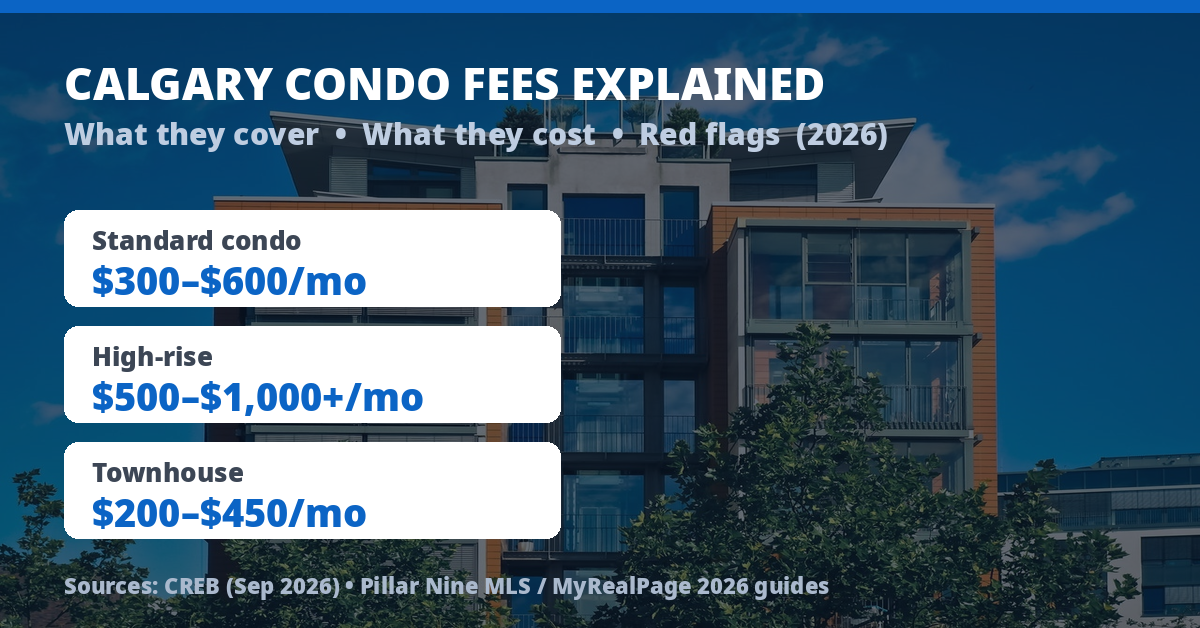
The short answer: Calgary condo fees are monthly payments that owners make to their condo corporation to cover shared operating costs — building maintenance, insurance, utilities, management, and contributions to the reserve fund for future repairs. Typical 2026 costs run $300–$600 per month for standard condos, $500–$1,000 or more for high-rise buildings, and $200–$450 for townhouse complexes.
If you are shopping for a condo in Calgary, the sticker price is only half the story. Condo fees (sometimes called condo contributions) can add hundreds of dollars to your true monthly cost — and two similar-looking units can carry very different fee loads. This guide breaks down what calgary condo fees actually pay for, what they cost in 2026, how to read a condo budget before you buy, and the red flags that should make you pause.
How Much Are Calgary Condo Fees in 2026?
There is no single average that fits every building, because fees follow the building's budget and amenities. But MLS-sourced 2026 data gives a clear picture of the typical ranges across Calgary:
| Building type | Typical monthly fee (2026) | What drives it |
|---|---|---|
| Standard apartment-style condo | $300–$600 | Moderate amenities, professional management |
| High-rise condo (full amenities) | $500–$1,000+ | Elevators, concierge, gym, pool, underground parking |
| Townhouse complex | $200–$450 | Fewer shared systems, no elevators or lobbies |
| Luxury / pinnacle buildings | $1,000–$2,000+ | Premium services, extensive amenity packages |
Source: 2026 Calgary condo fee guide compiled from Pillar Nine MLS® and MyRealPage listings, reported by bestcalgaryhomes.com (updated 2026).
Another way buyers compare buildings is the per-square-foot rate. A 2026 newcomer guide puts Calgary at roughly $0.40–$0.80 per square foot per month — so a 600 sq ft condo works out to about $240–$480 per month (welcomeaide.com, 2026). An MLS-compiled 2026 guide narrows the common band to roughly $0.45–$0.70 per square foot for typical buildings (bestcalgaryhomes.com, 2026). Anything far above that range is worth investigating before you write an offer.
For context, Calgary's apartment benchmark price sat at $291,400 in September 2026, down 8.3% year over year (CREB, September 2026). With purchase prices softening, monthly fees make up a bigger share of the true cost of owning — which is exactly why fee diligence matters right now.

What Do Condo Fees Cover in Calgary?
Every condo corporation sets its own annual budget, and the fee is your share of it. While the exact mix varies by building, condo fees in Calgary typically cover:
| Fee component | What it pays for |
|---|---|
| Day-to-day operations | Snow removal, landscaping, hallway and lobby cleaning, garbage collection, elevator maintenance |
| Building insurance | The corporation's master policy on common areas — you still need your own contents and liability insurance |
| Utilities | Heat, water and sewer are often included; electricity is frequently billed separately — this varies widely by building |
| Property management | The management company's administration, accounting and maintenance coordination |
| Reserve fund contributions | Savings earmarked for future major repairs: roof, elevators, parkade membranes, windows |
| Amenities | Gym, pool, sauna, guest suite, party room, concierge or security staff |
The single biggest variable is what is included versus billed separately. A $450 fee that covers heat, water and basic cable can be a better deal than a $320 fee that covers almost nothing. Always compare fees line by line, not just the headline number.
How Are Condo Fees Calculated?
Condo fees are calculated from your unit's proportional share of the building — usually tied to your unit's square footage relative to the building's total (welcomeaide.com, 2026). If your unit represents 2% of the building's total area, you pay roughly 2% of the annual operating budget, divided into twelve monthly payments.
The share assigned to each unit (the "unit factor") is set out in the registered condo plan. It does not change just because the board feels like it — reallocating unit factors requires a formal process. What changes year to year is the budget, which is what your monthly fee actually funds.
Apartment vs Townhouse: Which Has Higher Condo Fees in Calgary?
Townhouse-style condos usually carry lower fees than apartment buildings, because there are fewer shared systems to maintain — no elevators, no heated underground parkade, no concierge desk. Here is how the two typically compare:
| Apartment / high-rise condo | Townhouse complex | |
|---|---|---|
| Typical monthly fee (2026) | $300–$1,000+ | $200–$450 |
| Biggest cost drivers | Elevators, parkade, concierge, pool | Roofing, exterior, landscaping, snow removal |
| Utilities included | Often heat and water; electricity usually separate | Often fewer utilities; check each complex |
| Special-assessment risk | Higher ticket items (elevator modernization, parkade repairs) | Lower per-event cost, but roofs and siding add up |
Fee ranges: bestcalgaryhomes.com 2026 guide, compiled from Pillar Nine MLS® and MyRealPage listings.
Lower fees are not automatically better. A townhouse complex with rock-bottom fees and a thin reserve fund can hit you with a five-figure special assessment when the roofs come due. The health of the budget matters more than the size of the fee.

How Do You Read a Condo Budget Before You Buy?
In Alberta, buyers can request the condo documents before removing conditions. Ask for the full package — and actually read it. The documents that matter most:
- Annual budget: Is spending in line with the fees being collected? Look for line items that seem inflated or suspiciously low.
- Reserve fund study: This engineering report estimates future repair costs and recommends how much the fund should hold. Compare the recommended funding level to what is actually in the bank.
- Meeting minutes (last 12–24 months): Owner disputes, upcoming projects, and special assessments get discussed here long before they hit the budget.
- Bylaws: Rental restrictions, pet rules, and age restrictions can affect your plans and your resale pool.
- Insurance certificate: Note the deductible amounts — high deductibles often get passed on to individual owners when claims happen.
- Information statement (estoppel): Confirms the current fee amount, whether the seller owes arrears, and whether any special assessment is pending.
If the documents are thin, disorganized, or the seller resists providing them, treat that as information in itself. A well-run corporation produces clean paperwork.

What Are the Red Flags in Condo Fees?
Not every high fee is a problem — and not every low fee is a bargain. These are the warning signs that deserve a second look:
| Red flag | Why it matters |
|---|---|
| Reserve fund far below the study's recommended level | Future repairs have to come from somewhere — usually a special assessment billed to owners |
| Fees jumped sharply in a single year | Suggests deferred costs catching up, or a budget that was unrealistic for years |
| Special assessments every couple of years | Points to chronic underfunding rather than one-off surprises |
| Active litigation against the corporation | Legal costs and potential payouts create unknown future liabilities |
| Visible deferred maintenance | Stained parkade ceilings, broken intercoms, worn common areas — the money is not being spent where it is needed |
| Minutes full of owner disputes | Governance problems often show up in the budget eventually |
One or two of these in isolation may have an innocent explanation — ask the property manager directly. A cluster of them is a pattern, and patterns are expensive.
Frequently Asked Questions
Can you negotiate condo fees in Calgary?
No. Condo fees are set by the condo corporation's board based on the approved annual budget — they are not negotiable with the seller or the board. If the fees feel too high for your budget, the practical move is to buy in a different building with a leaner budget.
Do condo fees include property tax?
No. Property tax is billed separately by the City of Calgary. Condo fees and property tax are two different monthly costs, and your true monthly housing cost includes both — plus insurance and utilities not covered by the fees.
What happens if you stop paying condo fees in Alberta?
The condo corporation can register a lien against your unit under Alberta's Condominium Property Act and recover its collection costs from you. Condo fees are a legal obligation of ownership, not an optional subscription — budget for them the same way you budget for the mortgage.
Do condo fees go up every year?
Not necessarily, but the board reviews the budget annually and adjusts fees when operating costs rise. Steady, modest increases are normal and healthy — they usually mean the board is keeping the budget honest. Sharp jumps deserve a closer look at the underlying budget.
If you are comparing condos, read the fee history and the condo documents before you fall in love with the kitchen. Fees shape your monthly cost for as long as you own the home. Browse Calgary condos for sale, run your true monthly cost with our mortgage calculators, or reach out for a no-pressure walkthrough of any building's documents — including how its fees stack up against similar buildings. For the price side of the equation, see our Calgary condo prices guide.
Posted by Ray Yang onEnjoy this blog post? Click here to subscribe for updates
Leave A Comment